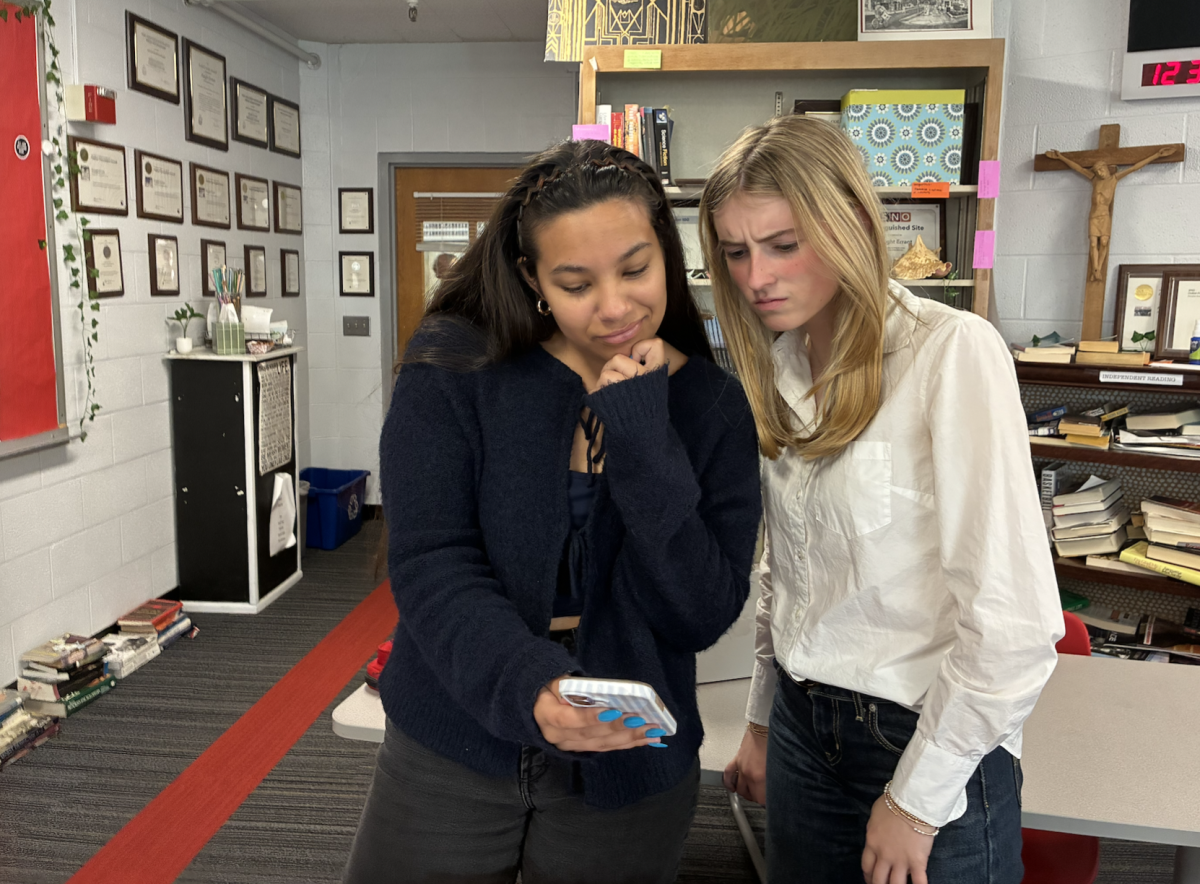
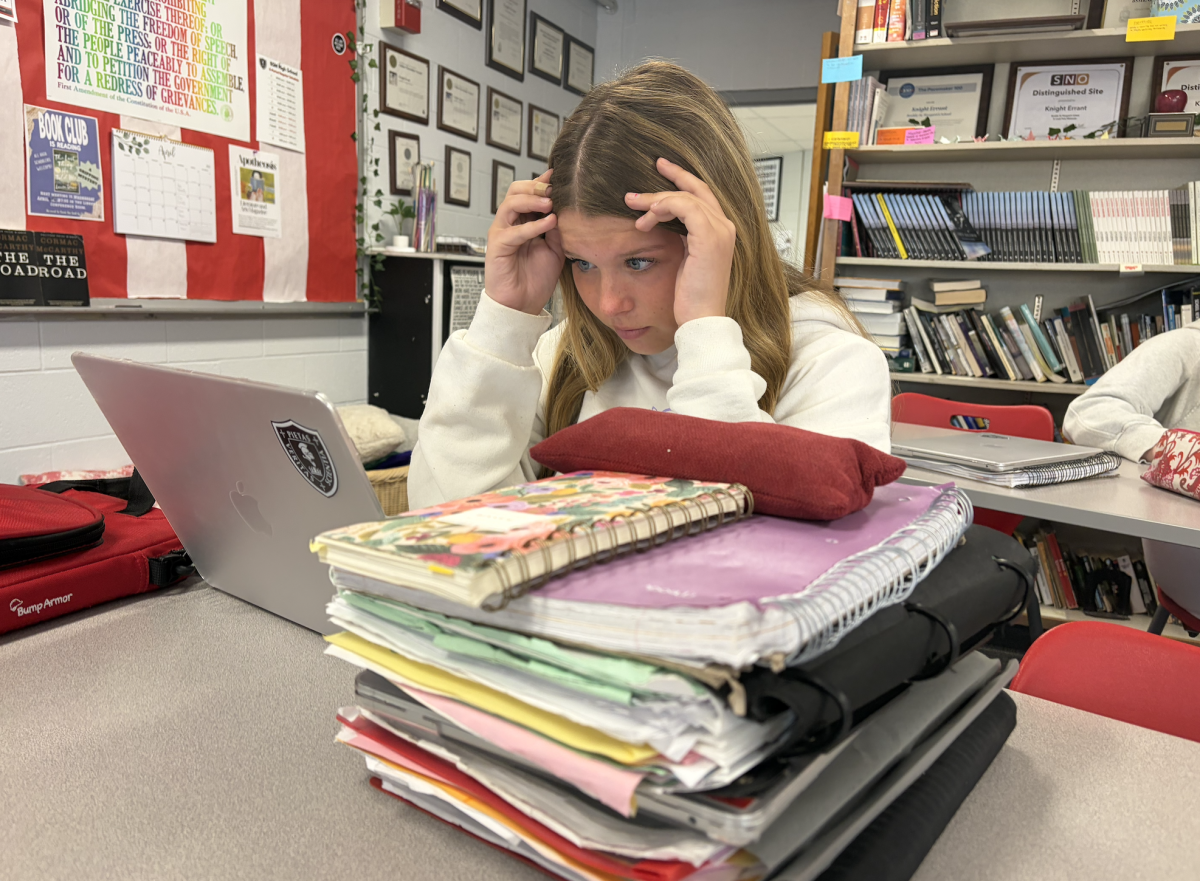
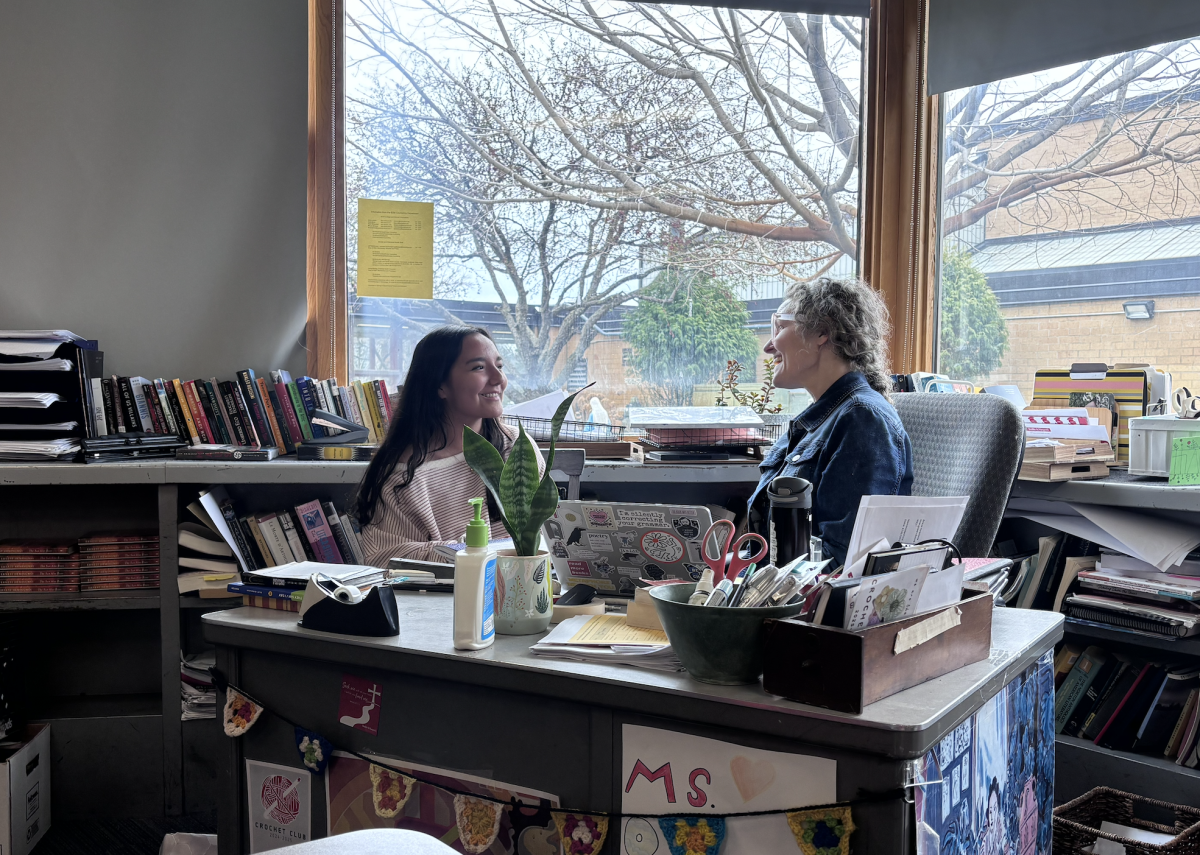
Earlier this year, Knight Errant editors were invited by 7th-grade English teacher Ashley Lee to give a lesson on the basics of news journalism to her students.
The assignment was focused on informative writing and writing without bias. After she heard BSM had a school newspaper, Lee thought her students would engage with the assignment better if they heard from other students who do the same thing. “I really liked the thought that they [the students] could actually, hopefully work with the news editors to have the real-life experiences. When the students can see that something’s real, they connect with it better, and they usually also try harder,” Lee said.
The editors gave a short presentation to each of Lee’s classes, touching on interviews, how to write questions, and how to integrate quotes into a story. “I was really excited because in seventh grade, I didn’t have any experience with journalism or anything like that, or writing stories and that type of structure, so it was fun to teach them how to write a story, how to pull quotes, and just write everything in the correct way,” Knight Errant Editor-in-Chief Claire Ryan said, “But it was also a little intimidating, because seventh graders didn’t exactly want to talk.”
Seventh graders then pitched their own stories, conducted interviews, and wrote either a news or a student life story. After working with the students to edit their stories, the Knight Errant published some of these stories below.
BSM alum Michele LaBore reflects on her time at BSM during the 80s. (
Grace Hennessey )
What Benilde-St. Margaret's Was Like in the 1980s
Grace Hennessey, Guest Writer
Being a Benilde-St. Margaret’s (BSM) student can have a lasting impact. Michele LaBore, a 1987 graduate from BSM, reflects on her time as a student there.
In the 80’s, BSM was similar to how it is today when you think about friendships and how classmates enjoy spending time together. Michele Labore shared who her friends were at the time when she was a BSM student. "I had a lot of best friends because I was extremely popular, but I did roll with a lot of different clicks, from the sports, athletic guys, the nerds, the hippies and the rock and rollers and but mainly . . . We loved music. We loved going to shows. We loved singing in the car on the way to school and a lot of our fun together was around music,” LaBore said.
When LaBore was at BSM, it had a great community, and now in the 2020s, BSM still has that same great community. LaBore said that she loved the BSM community activities the most. “It would probably be plays. I was in a couple of plays, and that was a lot of fun . . . And just the community, the activity and the people that were in it were a lot of fun to hang out with,” LaBore said.
LaBore mentioned that she loved BSM and misses the school as a whole. Since her time at BSM, what she has loved the most is the BSM community. “I miss the community. . . I missed just the friendship and the communities and the quality time spent with people that I was so close to back then. But I also miss the really great education. And we certainly learned a lot, going there, that they always had quality teachers and events, productions, plays, and music events. . . So I think it's more about the activities in the community that I miss most,” LaBore said.
LaBore shared that she was able to go off campus to have lunch. Because younger BSM students can't go off campus now, this is a change from the past rules. BSM has changed a lot since the 80’s, and this change is for the better due to safety. “Quite honestly, we could go off campus a lot during our lunch hour and our free hour when I was in school, so I wouldn't necessarily eat in the cafeteria. I would take advantage of that. We'd go to McDonald's or down the road,” LaBore said.
One wellness activity is fly tying with Greg Hoemke, a 7th-grade literature teacher. (
Charlotte Trella )
Wellness Time For Middle School Students
Charlotte Trella, Guest Writer
Wellness was designed as a time for middle school students to have fun, do activities, and release energy. Although the goal of wellness is for students to learn new things, to relax, or to channel excess energy, this doesn’t mean that these things are happening.
BSM middle school students can have energy boosts throughout the day from certain things. Wellness can increase those energy boosts because kids can see friends, different environments, or teachers can change their energy or mood. A survey conducted across 7th-grade students at BSM showed that 45.9% of students are affected by wellness in a positive way. Wellness can have an effect on students, and this effect should have a look to see if it is doing what it was planned to do. “I think they get really crazy in the classroom. I myself have done that, and it's just not very good, because it gets the teachers annoyed, and then we get annoyed at the teachers for yelling at us, and then we might even get a tier one, if we get too crazy. So it's not very good,” 7th-grade BSM student Anna Rudowsky said.
Wellness is around twenty minutes long. Some who have participated in wellness time might want more or less time depending on how they’re feeling. A survey conducted across 7th graders at BSM showed that 58.1% of 7th graders said that they should get more wellness time. “I definitely think wellness should be changed. I think we should lengthen the time some more. I also think we should have more resources out there, instead of having the kids bring it because we might forget. Maybe have a bin of all the stuff we could use, and then we could help bring it back inside,” Rudowsky said.
Screens are used frequently in class, and having wellness could be beneficial to students' mental health, because it’s a time when students don’t use their screens. Lastly, exercise may be beneficial to students after spending time in class. “I think the outdoors is a great chain of scenery. We are always on our computers every single second in class, and whenever we look at stuff that teachers are doing, it's usually on the smart board. So it's just screen, screen, screens. And it's really nice, especially in the winter to see the snow and see the greenery. It's just better,” Rudowsky said.
The white rose on this 9/11 memorial represents someone’s birthday that they would have been celebrating, had they not lost their life. (
Grace Vickery )
BSM on 9/11
Grace Vickery, Guest Writer
On September 11th, 2001, BSM faculty and students joined together as a community to support each other following the events that occurred that day. The school joined together as terrorists attacked the Twin Towers and other places on the East Coast of the U.S. The terrorists flew planes into buildings, causing harm, pain, and killing hundreds of American people, including some people connected to the BSM community.
It was a normal school day. Kids were in their regular classes. Word spread when faculty turned on their TVs, and people realized that our country was under attack. Students and faculty joined together to support each other. “So that whole day was kids in and out of the chapel. I was there all day supervising and praying with kids. Teachers were talking about it in their classrooms. It was a different feel in the whole school on that day,” BSM campus minister Mike Jeremiah said.
While connecting with each other in the chapel that day, people experienced many emotions. “The chapel was filled with kids and with adults. Some people were crying, and some people just did not know what to do. There were kids back then who had relatives who worked, not in the Twin Towers, but near there. And so they were uncertain as to whether their relatives were hurt or injured or dead,” Jeremiah said.
This tragedy happened so far away, but members of BSM’s own community were still personally impacted. The community at BSM is so strong that even when a confusing and heartbreaking thing is happening, people can still be there for their friends who are being affected. “You're watching the news happening, and then, you know, there's a person in the classroom down the hall that her dad might be, you know... No one could get a hold of him. So, yeah, very, very scary,” Rico Diaz ‘02 said, who was a student there at the time.
This event was very surprising and unexpected for everybody. It was clear, even on that day, that things would never be the same. Everyone knew they would remember what they were doing on that world-changing day. “It's definitely unprecedented, and unlike anything we had ever, you know, heard of. I mean, I remember when I was growing up, it was kind of always talking to older generations about, like, the Kennedy assassination,” Diaz said.
The BSM football team under the bright lights Friday night. (
Addy Brown )
Beyond the Huddle
Matthew Chapman, Guest Writer
Brad Anderson is the 2025 Benidle-St. Margaret’s Varsity Football Head Coach. His philosophy for player development consists of improvement, effort, and life lessons.
Anderson’s goal is to see his team succeed, so he implements a philosophy that fosters continuous learning and dedication both on and off the field. Each football season provides Anderson with the opportunity to challenge each student-athlete. He believes in hard work, and he wants his players to understand that dedication during practices is just as essential as performance in games. He emphasizes that small, steady improvements each day will help them achieve their ultimate goal. “It’s not where you start, it’s the fact if you can get a little bit better each day, by the end of the year, you’re going to have a good team,” Anderson said.
Anderson asks his players to give their best effort every day, whether on the practice field or in the classroom. He continues to stress the importance of persistence and perseverance. Mandatory table sessions before each practice help players keep up with homework, exemplifying his dedication to this concept. “We talk about the fact that what we ask of each player is to give their best effort every day, and that doesn’t just go for football, that giving your best effort isn’t a sometimes thing, it’s an all the time thing. So whether you’re in the classroom, whether you’re studying, or on the practice field, whatever you’re doing, we just want you to get the full effort,” Anderson said.
Coaching high school football provides Anderson with the unique opportunity to teach beyond the football field. Sports in high school teach the importance of teamwork and discipline; they also instill resilience and a strong work ethnic. “I try to look for things we can do and focus on making sure that we’re playing to our strengths and not focusing on what we can’t do, because no one’s going to be the perfect player and be able to do everything and no team’s going to be the perfect team. Coaching sports is really part of your education, much like taking a class in science or math, and you learn stuff that you can use later in life. You learn things playing sports that you can use later in life,” Anderson said.
Students take four classes on block days, as opposed to eight on other days. (
Knight Errant )
Block Days at Benilde-St. Margaret's
Siri Bleichner, Guest Writer
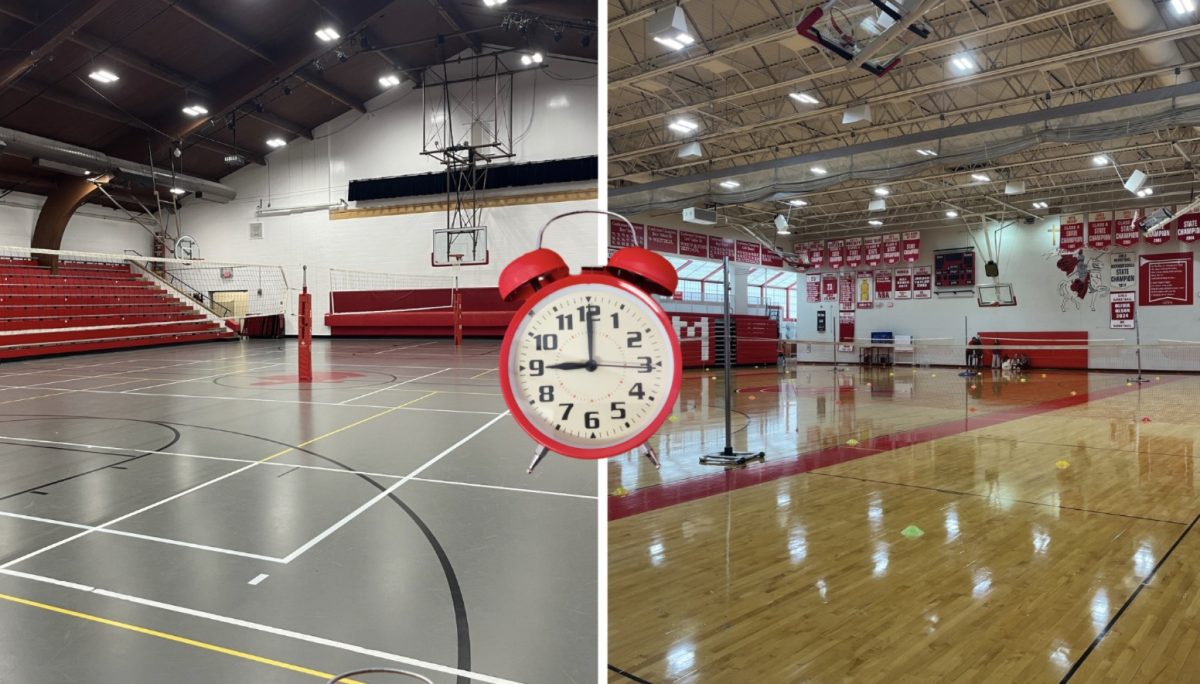
This year, the BSM students have a block schedule. A block schedule is where students take eight classes, but divide them into two different days. Every day they switch between odd classes and even classes.
Block days were introduced for the convenience of classes. Some classes need more time, so that’s why block days were added. If all the days were on an eight-period schedule, then some of the classes wouldn’t have time for projects, discussions, etc. “When I first came to BSM, we had two days that were block days and three days that were eight periods. And the reason that we have eight [period days] or the block days in that situation was because some of the classes like science or theology or history have labs or socratic seminars or things that, like discussions that would take longer than a 40-minute class,” BSM middle school principal Rikki Mortl said.
Mortl explained that she used to be a science teacher, and how she used to need time to do a lab. She likes how the longer classes allow teachers to fit more into a class. “I think that for some classes, they work really well, because, like I said, science, if you're going to do a lab, it can be really hard. I used to be a science teacher, and it can be really hard to try and do a lab,” Mortl said.
The block schedule started during COVID. Exposure played a big role in the block days, besides just the need for longer classes. Mortl says how they were in session every day, but most schools weren’t. “We switched during COVID to all block days, so that every day was blocked. So during the 2020 school year, we were in session. A lot of schools weren't in session, but we were in session every day. . . we needed to cut down on the exposure, or I guess, exposure that kids had to other students,” Mortl said.
Mortl says COVID was the main reason BSM switched to block days. After COVID, the days went back to a normal schedule, but they added block days within the eight-period days. “Covid was the reason that we switched to all so, like, every single day It was a block day. And then after COVID, I think it was like three years ago, then we added back in an eight-period day, which is why we have now, in a normal week, four blocks and one eight-period day,” Mortl said.
Both the 7th graders and the editors enjoyed working with each other, and Lee hopes to run a similar assignment next year. “They liked working with you guys [the editors]. They liked it when you came in, when the lessons weren’t super long, which helps with their attention. But then, especially on the days when you [the editors] went around and were helping with their stories, I could see how much that helped,” Lee said.
The editors encourage the 7th-graders to continue to write and hope some will join the Knight Errant when they get to high school. “Some of them were actually really interested in it, and were actually taking it pretty seriously. And I think it’s just a good thing for them to think about. [They might] be interested in it in a few years,” Knight Errant sports editor Brooke Hillins said.