

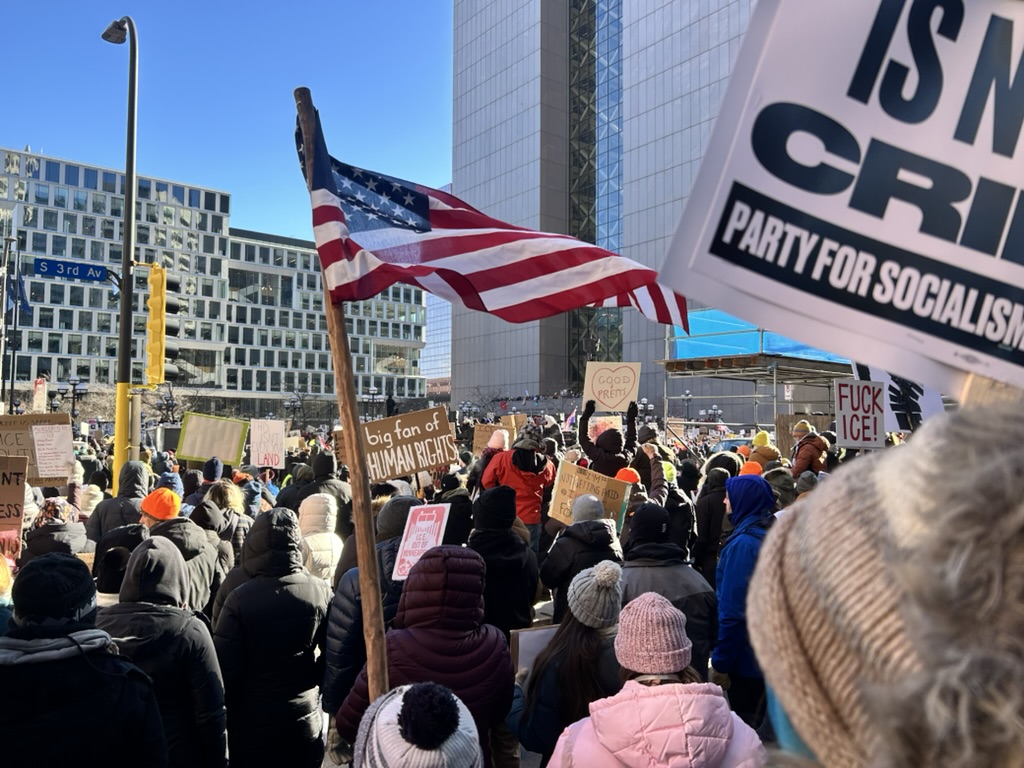

In Minnesota, tensions were high in the Twin Cities because of U.S. Immigration and Customs Enforcement (ICE) agents and the steps that they were taking to remove undocumented immigrants from the United States. Many people were affected by the presence of ICE agents in Minneapolis, and the impact on the city was undeniable.
During “Operation Metro Surge,” there were over 4,000 federal agents and ICE agents deployed to Minnesota, but in February of 2026, they began to withdraw hundreds of these officers from the state due to intense backlash from the community. Many Minnesotans united in protest across the Twin Cities. Now, the Department of Homeland Security states that only about 500 ICE agents are remaining in the state of Minnesota. “I don’t believe they ever should have been here in the first place. Customs and Border Patrol is supposed to work on the border, not 400 miles inland, where the Twin Cities are,” protester Andrew Janis said.
President Trump explained that he targeted the state of Minnesota to focus on the removal of immigrants and the downsizing of gang activity in the Twin Cities. He also stated that the violent responses of ICE agents were due to the uncooperation of undocumented immigrants, which led to the need for agents to conduct increased street-level enforcement. “The United States has a right to protect its border, but we have a responsibility to do it in a really humane way and in a way that protects the dignity of every human person,” theology teacher Becca Meagher said.
Some of the more recent widely known murders of people in Minnesota by ICE agents include Renee Macklin Good and Alex Pretti, who were both shot. The murders did not cause any withdrawals from ICE agents, but instead escalated the federal immigration presence in the state. “It’s about hatred and lack of empathy,” Janis said.
Under the Fourth Amendment, federal agents do not have the right to search or question people unless they have reasonable suspicion that a crime has been committed. According to the amendment, being Hispanic is not enough reason to violate the privacy of an individual’s property or pursue violent confrontation. At Benilde-St. Margaret’s, standards for social justice and support of immigrant communities were made clear through online posts and public support of the immigrant community. “The Catholic bishops are very clear on what our role is as Catholic members of communities: to always uphold the life and dignity of the human person in every instance. And we saw very clearly that human dignity was being violated in how ICE was operating. And so that’s our call,” Meagher said.
Many videos surfacing on the internet show graphic depictions of individuals being dragged through car windows, down streets, and tear-gassed by ICE officers. ICE officials are legally only allowed to stop a vehicle due to reasonable suspicion that a person within the vehicle is breaking some sort of law. In many cases, ICE officers targeted people who appeared Latino, with not much reason other than their visible race, which led to confrontation. Most often, the individuals being attacked were not guilty of suspicious activity, but it was proven that many officers still approached the situation aggressively. Data makes it evident that between January 20th and July 28, 2025, ICE made more than 16,000 street arrests of immigrants with no criminal convictions, charges, or removal orders. ICE officers were placed in Minnesota in order to detain criminals, and statistics show that the majority of people that they took into custody were not guilty of violent crimes. In fact, less than 14% of about 400,000 immigrants who were arrested by ICE during Trump’s first year had charges for violent criminal offenses. “The vast majority of immigrants I’ve ever met are here because they want to work, and they want to make a better life for their family,” Janis said.
The presence of ICE while they were in Minnesota caused many Hispanic people to stay indoors, which led to many businesses struggling with revenue losses. Minneapolis experienced $203.1 million in impact on the economy, mental health, and food and shelter security. “It’ll harm people’s mental health for the future… Especially if you think about elementary school-age students who had to wonder why classmates were gone,” Meagher said.
Schools across Minneapolis were also affected significantly by the impact of ICE’s presence in the city. Minneapolis Public Schools were canceled through January 7-9 because of safety concerns for their students after an incident at Roosevelt High School. “I think people’s long-term mental health [will be affected] and even their long-term ability to feel safe, especially if they’re a person of color, especially if they’re an immigrant family,” Meagher said.
At Roosevelt High School in Minneapolis, armed U.S. Border Patrol officers came on school property during dismissal on January 7th, 2026. They had seemingly no indication to believe that they needed to take violent measures, but they proceeded to handcuff two staff members, tackle people, and release tear gas on innocent bystanders. Many students ran for shelter at a nearby library. Following the event, hundreds of students walked out in protest of the violent measures that ICE agents had taken in the city. Parents of students in Minneapolis claim that the impact was not only robbing students of their opportunity to learn, but also of their innocence. “ICE’s presence really affected and hurt the students in my community, especially at Roosevelt,” Roosevelt student Bryce Williams said.
This incident, along with many others in Minneapolis involving ICE officials, caused many people to struggle with mental health and anxiety due to the intensifying fear for their neighbors. For many people, constant exposure to breaking news about enforcement abuses is continuing to take an extreme mental toll, and the stress is not temporary but proven to be destabilizing. Some reports stated that some students had begun to share with their teachers about the intensifying fear of their parents, and students who were normally engaged in class had begun to withdraw. “There’s been a trauma inflicted on this community that is going to be part of the fabric of this community forever, and that’s not even talking about the people that have been personally affected by the two murders that took place here,” Janis said.
During “Operation Metro Surge,” many immigrant families were torn apart. The image of 5-year-old Liam Conejo Ramos surfaced with the story of him being detained, famous for the fearful look on his face and his bunny hat. Many members of the Minneapolis community were upset by the idea of a child being taken into custody, and asked others to remember the second amendment to “love thy neighbor,” despite the color of their skin or their immigration background. “Rights need to be respected, because that’s part of what makes us American, that we do respect those rights, and we respect all people,” Janis said.
Effects of ICE still linger in Minnesota, with many people feeling the need to evacuate out of fear. Even U.S. Citizens didn’t feel comfortable living in the city of Minneapolis, and began moving into the suburbs and sometimes other states in search of safety for themselves and their families. This fear contributed to the growing tension around ICE presence. “The ideals that this country was founded on were that all men were created equal, and that we have inherent rights just because we are Americans. You have rights if you are standing on the soil, no matter who you are, and those rights need to be respected,” Janis said.
Many people across the world were stunned by the unity of the community of Minneapolis to help their neighbors. Because of their resilience, solidarity, and non-violent protesting, the city of Minneapolis has been nominated for the Nobel Peace Prize by “The Nation.” “The damage caused by Operation Metro Surge doesn’t disappear just because the operation is ending. Families were torn apart, small businesses lost millions, and students had their learning disrupted. That impact is real. But Minneapolis has never let hardship define us. We will do what we’ve always done: rebuild even stronger — united in the city we love,” Minneapolis Mayor Jacob Frey said.